Article
11 Minute Read

Last Update






Key takeaways
Philippine holidays are split into two legal categories, Regular Holidays and Special Non-Working Holidays, and the pay rules are really different for each. Mixing them up is an easy mistake to make.
Work a Regular Holiday and your employee gets double pay. Don't work it, and they still get their normal daily wage.
Special Non-Working Holidays flip that logic. No work means no pay by default, unless your own policy says otherwise, and there's a premium if someone does work.
Two dates on the calendar below, Eid'l Fitr and Eid al-Adha, move every year because they're set by lunar sightings. The government doesn't lock them in until a presidential proclamation closer to the date.
If you're running a remote or outsourced team in the Philippines, the category matters more than the date. That's what actually tells you what you owe.
Type “Philippine holidays” into Google and you'll land on the same content over and over: a list of dates. The Official Gazette puts out the official proclamation. Sites like Wikipedia copy it into a clean calendar. None of it is wrong. It's just not written for anyone who's actually running payroll for a Filipino employee.
Here's what those lists skip over. Whether a specific date is paid or unpaid by default. What happens if someone works it anyway. How to plan a deadline around a week that quietly turns into three days off. This isn't a tourist's calendar. It's a payroll one, with the dates included so you're not hunting for them somewhere else.
Regular Holidays vs. Special Non-Working Holidays: The Difference That Actually Matters
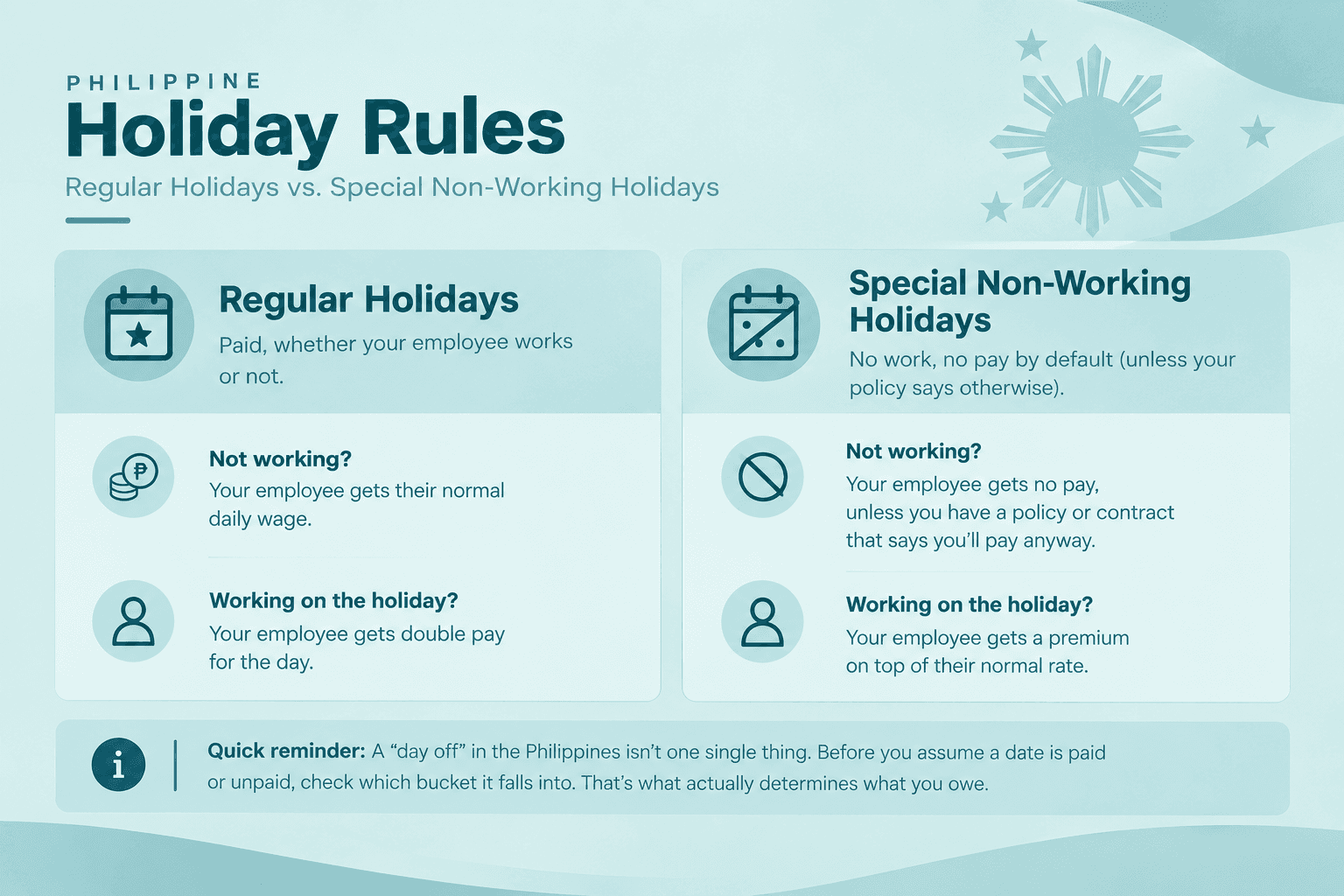
Philippine law splits holidays into two buckets, and mixing them up is probably the most common mistake we see employers make when they're new to hiring in the Philippines.
Regular Holidays are simple once you know the rule. Full pay whether the employee works or not, and double pay if they do. No exceptions, no fine print.
Special Non-Working Holidays work the opposite way. The default is no work, no pay. Your employee only gets paid if you've written a policy or contract that says you'll pay anyway, and if they do work, they're owed a premium on top of their normal rate.
So a “day off” in the Philippines isn't one single thing. Before you assume a date is paid or unpaid, check which bucket it falls into. That's the part that actually determines what you owe.
Philippine labor law has exceptions and local quirks, so if real money is riding on a specific date, run it by your EOR partner or a licensed professional instead of trusting a blog post, including this one.
The Full Philippine Holiday Calendar
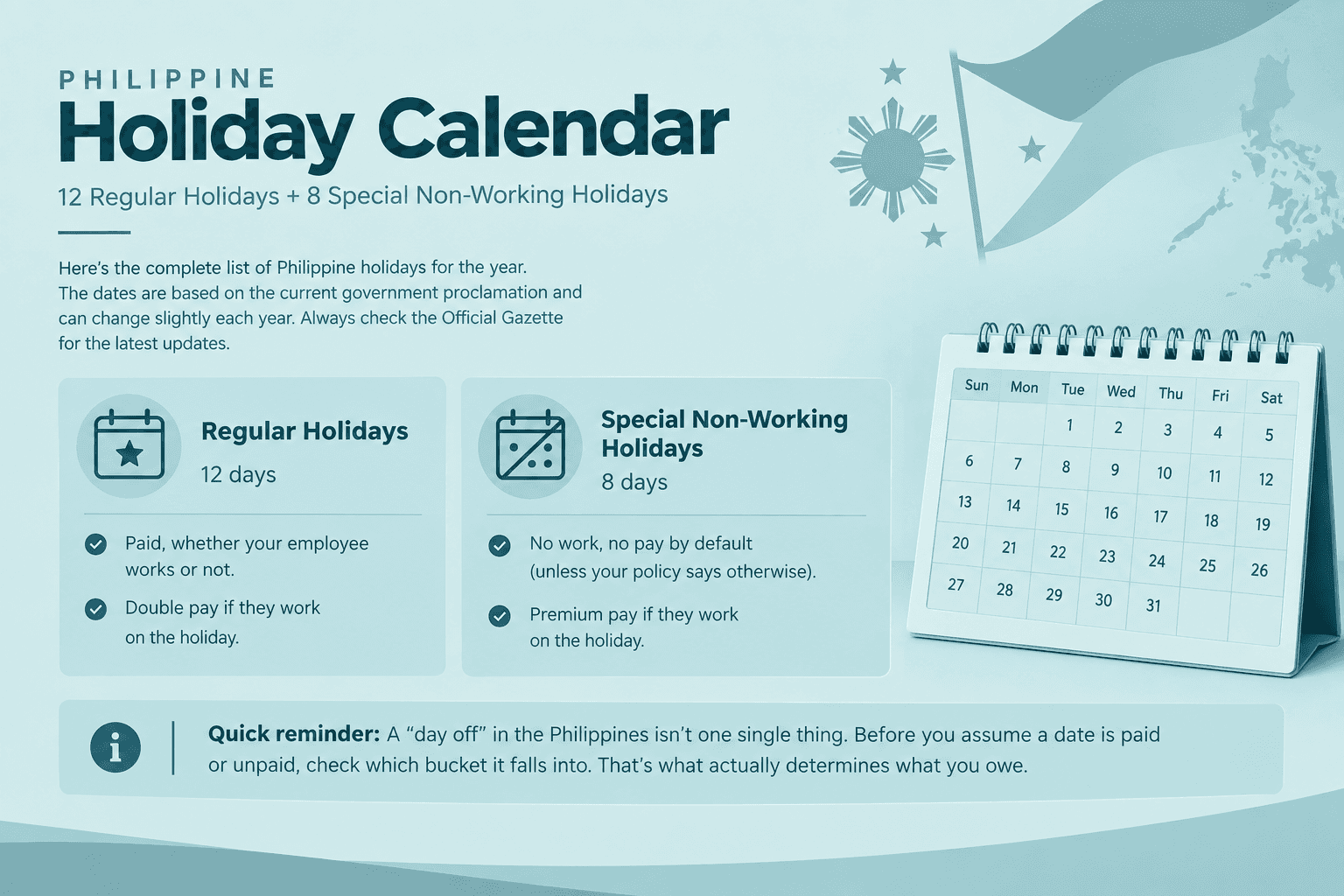
The list below is the current published calendar: 12 Regular Holidays and 8 Special Non-Working Holidays. Weekday alignment shifts a little every year, so double check against the Official Gazette before you lock in a deadline or a payroll decision around any of these.
Regular Holidays
Date | Day | Holiday |
Jan 1, Thu | Regular Holiday | New Year's Day |
Mar 20, Fri | Regular Holiday (movable) | Eid'l Fitr |
Apr 2, Thu | Regular Holiday | Maundy Thursday |
Apr 3, Fri | Regular Holiday | Good Friday |
Apr 9, Thu | Regular Holiday | Day of Valor (Araw ng Kagitingan) |
May 1, Fri | Regular Holiday | Labor Day |
May 27, Wed | Regular Holiday (movable) | Eid al-Adha |
Jun 12, Fri | Regular Holiday | Independence Day |
Aug 31, Mon | Regular Holiday | National Heroes Day |
Nov 30, Mon | Regular Holiday | Bonifacio Day |
Dec 25, Fri | Regular Holiday | Christmas Day |
Dec 30, Wed | Regular Holiday | Rizal Day |
Special Non-Working Holidays
Date | Day | Holiday |
Feb 17, Tue | Special Non-Working | Lunar New Year |
Apr 4, Sat | Special Non-Working | Black Saturday |
Aug 21, Fri | Special Non-Working | Ninoy Aquino Day |
Nov 1, Sun | Special Non-Working | All Saints' Day |
Nov 2, Mon | Special Non-Working | All Souls' Day |
Dec 8, Tue | Special Non-Working | Feast of the Immaculate Conception |
Dec 24, Thu | Special Non-Working | Christmas Eve |
Dec 31, Thu | Special Non-Working | New Year's Eve |
One thing worth mentioning: Eid'l Fitr and Eid al-Adha follow the Islamic lunar calendar, so the exact date isn't locked in until a presidential proclamation closer to the day. Treat what's listed above as a solid estimate, not a guarantee, and check for the update as the date gets closer.




What This Means If You Manage a Remote Team in the Philippines
Map the clusters against your delivery timeline early. National Heroes Day, Bonifacio Day, and Rizal Day all tend to land right next to a weekend, so what looks like one holiday on the calendar often plays out as a long weekend on the ground.
Put your Special Non-Working Holiday policy in writing before you need it. The default is no work, no pay, so if you want to pay anyway for consistency, say so up front. People notice when the rule seems to change depending on who's asking.
Don't assume a Regular Holiday means nobody's available. Some employees want the double pay and will happily work Christmas or New Year if you ask. Worth a direct conversation rather than guessing either way.
The April stretch is the one to watch. Maundy Thursday, Good Friday, the Day of Valor, and Black Saturday usually fall within about a week of each other. Build in slack there, and again around the Christmas Eve through New Year's Eve run.
Running hires across the Philippines, Latin America, and South Africa at once? Keep one shared calendar. Holiday overlap, or the total lack of it, causes more scheduling confusion than almost anything else on a distributed team.
If you haven't hired in the Philippines yet and you're still weighing it, payroll timing is a step too early to worry about. Start with our guide to hiring virtual assistants in the Philippines instead, it covers cost, vetting, and matching a role to the right person. The holiday calendar becomes relevant once someone's actually on payroll.
How Globaltize Handles This For You
Honestly, this is the kind of thing that falls through the cracks when a business tries to manage international hiring on its own, not because anyone's careless, just because nobody has time to track holiday law for six different countries. Every hire made through Globaltize runs through our contractor payments and EOR setup, so holiday pay, along with the rest of payroll and compliance, isn't something you have to manage by hand. Curious how the payroll side actually works day to day? We've laid out how payroll runs separately. And if a holiday cluster is about to mess with a deadline, your account manager will usually flag it before you have to ask.
FAQs
What's the difference between a Regular Holiday and a Special Non-Working Holiday in the Philippines?
Simple version: a Regular Holiday pays out either way, double if worked. A Special Non-Working Holiday only pays if the person works it, or if your own policy says otherwise.
Do I have to pay my Filipino remote employee on a Special Non-Working Holiday if they don't work?
Not automatically, no. The default is no work, no pay unless your contract or company policy overrides it. Plenty of employers pay anyway, mostly for consistency and goodwill, but that's a choice, not a legal requirement.
Are Eid'l Fitr and Eid al-Adha guaranteed to fall on the dates listed above?
No, and this trips people up almost every year. Both dates depend on lunar sighting and only get locked in by presidential proclamation shortly before the date. Treat the dates here as your best planning estimate, then confirm as the date gets closer.
How should I plan project deadlines around Philippine holidays?
Watch for clusters. A lot of these holidays sit right next to a weekend, which quietly turns one day off into three or four. Build your deadline buffers around those stretches instead of assuming a normal five day week.
Does this affect only Philippine-based hires, or should I check similar rules for Latin America and South Africa too?
Every region runs its own calendar and its own pay rules. If you've got hires spread across more than one, it's worth keeping a single shared calendar rather than tracking each country separately in your head.
The Bottom Line
A list of dates tells you the Philippines is taking a day off. It doesn't tell you what you owe, what coverage to expect, or how to plan a deadline around it, and that's exactly where most “Philippine holidays” content, including plenty of it from other companies, stops short.
The Verdict: if you're running a remote or outsourced team in the Philippines, the category behind each date matters more than the date itself. Get that right, and the calendar takes care of itself.