Article
8 Minute Read

Last Update






Key takeaways
Shared working hours come first, and a lot of the other benefits lean on them.
Costs are usually lower, mostly because living costs are. Pay too little and people walk.
You can hire far beyond call center work: sales, finance, marketing, design, tech, legal support, executive support.
English and working style often sit close to US habits. Close, not identical, so test it.
Compliance is where first-timers get burned. Pick your hiring model on purpose.
If you’d rather not run the search and the paperwork yourself, Globaltize does both.
Here’s the one that matters most: the person you hire in Latin America is awake when you are. Sounds minor. It isn’t, not once you’ve waited a whole day for the answer to a two-line question. Of all the benefits of hiring in Latin America, this is the one that makes the rest work, because a good hire who replies at 2 p.m. is worth more than a cheaper one who replies at 2 a.m. The others follow. Lots of candidates, strong English in plenty of cities, pay that stretches further. There are downsides too, and we’ll cover them, because a post that only flatters the idea isn’t much use to you.
Why More US Businesses Are Hiring In Latin America

Picture an ordinary Tuesday. You need an accountant, or a sales rep, or someone to take over your calendar. You post the role. Three weeks on, there’s a stack of CVs and nobody you’d hire, or one great person who wants more than you can pay. Meanwhile the work piles up on your desk.
Hiring abroad is the usual way out, and it comes with a catch. Someone twelve hours away works while you sleep. That’s fine for some jobs and miserable for others. Latin America takes away most of the catch. A person in Mexico City or Bogotá can sit in your morning stand-up, take a customer call over lunch and still be around at 3 p.m. when something breaks.
That’s the gap Globaltize was built for. We find, vet and support remote people so you don’t have to figure out a new country on your own, and you’ll see where that helps as we go through the eight benefits, more or less in the order people notice them.
1. Time Zone Overlap With The US
Let’s get specific. In winter, 9 a.m. in Chicago is 9 a.m. in Mexico City and 10 a.m. in Bogotá. Come summer the US moves its clocks and the picture flips a little: Chicago and Bogotá match, and Mexico City runs an hour behind. Colombia stays on Eastern Standard Time all year, and most of Mexico stays on Central with no clock change. Brazil and Argentina end up one to two hours ahead of Eastern, depending on the season. Check the numbers against your own hours, because daylight saving moves things around.
Here’s what that gets you in practice:
Same-day answers. A question you ask at 10 a.m. gets answered that afternoon, not the next morning, and nobody sets a 4 a.m. alarm for a live call.
Handoffs that work. You talk a task through for ten minutes, the person gets going, and you glance at a first pass before you both log off. With twelve hours between you, that same loop takes two days, and every “wait, what did you mean?” costs another one.
A teammate, not a contractor who gets back to you tomorrow. If your work faces clients, like sales, support or executive assistance, that’s the whole difference.
Set it beside the far side of the world and the trade is clear. Southeast Asia is great for work that doesn’t need live contact, or for coverage while your own team sleeps. Eastern Europe sits in the middle, with a shared window that closes early in the afternoon, Eastern time. Neither is wrong. They’re different tools, and since Globaltize recruits across Latin America, Southeast Asia and South Africa, you can match the region to the job instead of forcing one answer on every role.
2. Lower Costs Without Lower Standards
Most people come for the savings, so here’s where they come from. Salaries in many Latin American markets sit below comparable US ones, largely because everyday life there costs less. And you skip some US overhead, like office space and equipment.
We won’t hand you a headline percentage. Anyone who does is guessing. Two accountants in two countries can end up miles apart, so keep these three things in mind:
Look at the whole bill, not just the salary. Depending on how someone is hired, there can be employer contributions, the extra annual payment some countries require, paid leave, and a charge from whoever runs the hiring or the payroll. Contractors can look cheaper on paper until the classification risk shows up.
Pay fairly. Good people know what they’re worth. Offer far below the local market and you’ll get weaker applicants, or a resignation six months in.
Compare like with like. Latin America costs more than Southeast Asia, on average. That difference is what buys you the overlap, so weigh it against how much the overlap is worth for that particular role.
The hidden costs are mostly admin, and that’s where Globaltize helps. Payments, time tracking and compliance paperwork for your remote team sit in one platform instead of in three spreadsheets and an inbox.
3. A Deep Talent Pool Across Many Roles
Forget the call center picture. Mexico City, Bogotá, Buenos Aires and São Paulo all have real tech and services scenes, and plenty of people who’ve worked for international companies before. What does that mean for you?
Range. Support and sales people are there, sure, but so are accountants, bookkeepers, marketers, designers, developers, data people, recruiting support, legal support and executive assistants.
Seniority. Some have run teams at big employers. For a lot of owners that’s the draw: an experienced person at a level they couldn’t get locally.
Choice. A bigger pool lets you hold out for the right person instead of taking the first decent applicant, and it opens up roles you’d never have thought of sending abroad, like bilingual intake at a law firm, bookkeeping help for a finance team or social media for an agency.
Decide early whether you want a generalist or a specialist. Generalists, the email-scheduling-research kind, are easy to find. A bookkeeper who already knows your accounting software, or a developer in your exact stack, takes a narrower search. Globaltize recruiters run a custom search for each role, so that kind of request is routine for us. Browse the roles we recruit for to see the range.
4. Strong English And Bilingual Talent
Lots of professionals in the region use English every day, especially in business hubs and at companies with international clients. Many are bilingual in Spanish and English, or in Portuguese and English in Brazil. That comes with a bonus, since someone who can talk to your Spanish-speaking customers in their own language is something plenty of US businesses wish they had.
Don’t assume, though. English varies by person, not by country. Here’s how to check:
Talk to them live. Written English is easy to polish with a tool, and a spoken call isn’t.
Ask for a short writing sample as well, because some people speak fluently and write more carefully.
Try a role-play. Describe an angry customer, or a client who wants a deadline moved, and listen to what happens. Is the answer clear? Do they ask when they’re lost? Do they stay calm? An accent hardly matters next to whether you can understand each other on a patchy connection.
You don’t have to build all of that yourself. Globaltize screens candidates before you ever meet them, with tests and checks shaped around the role, and you finish with a conversation of your own.
5. Cultural Alignment With US Business
A lot of Latin American professionals have worked with US clients or companies. They know the holidays and what customers expect, and the style is collaborative and fairly direct. That’s why onboarding goes quicker than most people guess, and a new hire can feel like part of the team in a few weeks. Don’t lean on that too hard, though. It’s a huge region full of individuals.
A few habits help:
Spend the first few minutes of a call just being human. A warm, relationship-first style is common, and trust often comes before the work properly starts.
Tell them how you give feedback, then ask how they like to get it. Write every new task down. It removes more friction than you’d think.
Learn the holidays. Each country has its own, and some are big family occasions when almost nobody works. Ask for the list in week one and put it in a shared calendar, so a deadline never lands on a day the whole country is off.
After the hire, Globaltize keeps checking in. That helps most when a small misunderstanding is brewing and nobody has said anything yet.
6. Faster Hiring And Easier Scaling
A wider pool and workable hours usually mean quicker hiring. A role that drags on for months locally can often be filled far sooner, especially through a recruiter who knows the market. It matters most when you’re up against the clock: a sales push, a busy season, a backlog in support.
You don’t have to go big, either.
Start with one person. Hire, see how it goes, and learn what works for you.
Leave room for the steps that can’t be rushed. Vetting, a trial task, onboarding, and the notice period a good candidate with a job may owe first. Squeeze those and you’ll be hunting again in three months.
Add a second hire in another function once you’ve found a rhythm.
Here’s how our recruitment process fits in. We define the role with you, search and screen, then put a short list of finalists in front of you, with resumes and video intros, and handle the scheduling. Once you choose, we help with contracts, payroll setup, compliance guidance and onboarding. Every hire comes with a 12-month replacement guarantee, so if it doesn’t work out, you aren’t starting from zero.
7. Flexible Ways To Hire
There’s more than one route, and they aren’t interchangeable. Depending on the role and how much legal responsibility you’re happy to carry, you can pick from three main options:
Hire directly. You, or your own local entity, are the employer, so the contract and the paperwork land on you.
Use a staffing partner or an employer of record. A staffing partner finds the person and usually runs the arrangement. An employer of record is the legal employer in that country, handling payroll and contracts while you manage the daily work.
Engage an independent contractor. They work for themselves, send invoices and decide how the job gets done, so this route only suits work that’s truly independent.
Each swaps cost, control, risk and paperwork in its own way, and the best fit can change from country to country. Globaltize helps you work out which one suits the role, and its Workforce platform handles global payments, time tracking and compliance records for remote team members. Our page on contractor payments and employer of record explains how it works.
8. A Route To New Markets And Wider Coverage
This one gets overlooked. A bilingual hire can help you serve Spanish- or Portuguese-speaking customers, get a feel for a local market and start relationships that are hard to build from scratch. Because the region sits close to you in time, you can also stretch your hours without burning out your US team.
Serve more customers in their own language. A native speaker stops being a nice extra and becomes part of how you serve them.
Cover the hours you can’t cover today. Maybe the support inbox goes quiet at 6 p.m., or the leads that arrive at 7 a.m. sit there until somebody wakes up. One person in a nearby time zone can fill that gap, and nobody has to work nights.
Test a new market early. A bilingual teammate can read the local scene before you commit to anything bigger.
The Challenges You Should Know About
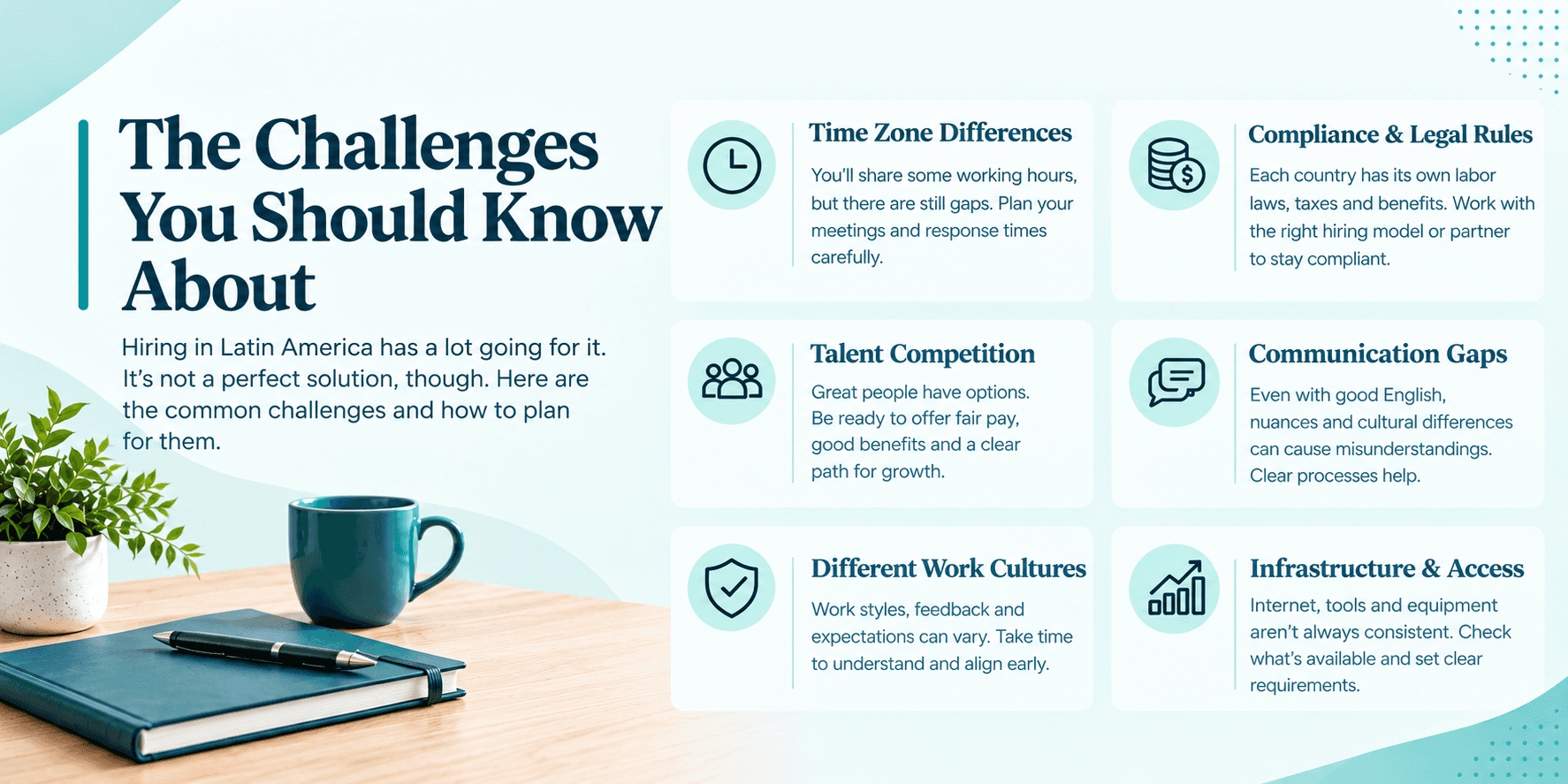
None of these should put you off. They just need a plan.
Start with compliance, because it’s where people slip. Employment rules, statutory payments and worker classification differ across the region. The classic error is labelling someone a contractor when they keep set hours, use your equipment and take daily direction from you. In many countries, what the relationship looks like in real life counts for more than what the contract says, and a wrong call can mean back pay, benefits and fines. Several countries, including Mexico, Brazil, Colombia, Argentina, Costa Rica and Peru, also require an extra annual payment for employees, often called a thirteenth-month payment. First-timers forget to budget for it. Take local advice, or use a partner that handles it. Globaltize helps with contracts, payroll setup and compliance guidance, so you’re not working out local rules by yourself.
The “one market” trap catches people too. Mexico isn’t Chile, and Brazil isn’t Argentina. Pay norms, language, culture and strengths all differ, and the popular countries are competitive for the best people.




Vetting is harder without local knowledge. A CV from a city or a school you’ve never heard of is tough to judge. Work samples, structured interviews and a short paid trial help, and so does a partner who knows the market. Globaltize’s vetting includes identity checks plus background and reference checks, and we show you finalists, not a pile of CVs. Whatever route you take, confirm the person you interviewed is the one doing the work, and set sensible access controls and data rules from day one.
Money gets fiddly. Some people want US dollars, some want local currency, and exchange rates and bank fees nibble at a payment. Settle the currency and the pay date up front, in writing.
Connectivity varies, so ask about reliable internet and a backup plan, especially for jobs with live calls. And if you’re on the West Coast, or you serve Europe or Asia, your overlap will look different. Check the hours before you commit.
Finally, remote people need managing. Clear expectations, regular check-ins, feedback. Working from home gets lonely, and a little human contact beyond task lists helps. A lot of “bad hires” were never bad. Nobody onboarded them.
Country Snapshots
Broad impressions to start a shortlist, nothing more. Every country has strong and weak candidates, and hiring always comes down to the person.
Country | Often a good fit for | Worth knowing |
Mexico | Customer support, sales, admin and bilingual roles | Close ties to the US market, and mostly on Central time |
Colombia | Customer support, sales, executive support and marketing | Same clock as US Eastern Standard Time year round |
Brazil | Design, marketing, tech and creative roles | Portuguese is the main language, so test English carefully |
Argentina | Tech, creative, finance and specialist roles | Strong specialist talent, and pay arrangements can need more thought |
Costa Rica | Bilingual support, admin and service roles | A practical choice for US Central hours |
Dominican Republic | Customer service and support | Often close to US Eastern hours, and many people speak English |
Our Latin America hub goes deeper on each country, with time zones, languages and the roles we hire most.
Roles And Industries That Work Well
Pretty much any job that doesn’t need someone in your office can work. Administrative and executive support, customer service, sales and appointment setting, bookkeeping, marketing, design and video, software, data, recruiting support. The list goes on.
Real estate, legal and healthcare practices, accounting and finance firms, marketing agencies, ecommerce, software companies and startups tend to look here first. They want the same things: overlap, solid English where it counts, and costs that make a senior hire possible.
For a first hire, choose something where you’ll see results within a couple of weeks. A weekly report. A clean inbox. A booked calendar. A finished set of reconciliations. Judge by output, not hours.
Is Latin America Right For You?
Latin America suits you if you need real-time work with a US team, your roles face clients, you’d like to grow in stages and you’re ready to manage someone remotely.
It suits you less if the work is fully independent and needs no overlap (a wider search might stretch your money further), if you need specialist local licensing, or if you can’t commit to onboarding and check-ins. Mainly after the lowest rate, or coverage while you sleep? Southeast Asia or South Africa may fit better, and Globaltize recruits there too.
How To Start Hiring In Latin America
Start by writing down what the person will do in their first three months and what good looks like. Then pick a country, or two, by matching your hours, language needs and role to the snapshots above.
Next, the hiring model: direct, partner, employer of record or contractor. It depends on what you need and how much risk you’ll carry. Then sourcing and vetting. Work samples, a live interview and, if you can manage it, a short paid trial tell you more than any CV.
When someone says yes, onboard them properly. Put expectations in writing, share your processes and agree when you’ll check in. A written set of instructions for each recurring task helps a lot. Then review early, weekly for the first month, and give feedback fast.
Do it all yourself if you like. Plenty of people do. But if you’d rather not spend your evenings wading through CVs, Globaltize can take that part off you. We work out the role with you, search, screen, and put a few finalists in front of you to meet. Contracts, payroll setup and onboarding are ours too if you want them, and every hire comes with a 12-month replacement guarantee. You choose who joins. Always.
Common Mistakes To Avoid
Hiring on cost alone. That’s the one we’d put first, because the person you hired cheap is often the first one a better offer takes away. Paying under the local going rate is the same trap. Then a handful of others: treating all of Latin America as one place, skipping a live English check, calling someone a contractor when they’re really an employee just so the paperwork is lighter.
The rest of the mistakes come after the hire. A manager goes quiet on the new person for a week. A deadline lands on a local holiday. Someone promises their boss a saving they never actually worked out. And system access gets handed around like candy, with nothing planned for the day that person moves on.
Frequently Asked Questions
What are the benefits of hiring in Latin America?
Overlapping hours, for a start. After that: lower costs for like-for-like roles, a big talent pool, solid English in a lot of cities, a work culture that fits US teams, faster hiring, a few different ways to employ people and a foothold in new markets. Globaltize recruits, vets and supports people across the region, so you get those benefits without running the search yourself.
What are the disadvantages of hiring in Latin America?
Mostly planning problems, not dealbreakers. Employment rules and worker classification differ by country, the extra annual payment some countries require catches first-timers out, and judging a CV from an unfamiliar city takes local knowledge. It also costs more than Southeast Asia, and the overlap shrinks if you’re on the West Coast or serve Europe or Asia. A partner who handles the contracts, payroll setup and vetting takes most of that off you.
Is it cheaper to hire in Latin America than in the US?
Usually, yes. By how much? Nobody can tell you without knowing the role, the seniority, the country and how you hire, so ignore any blanket percentage you come across. Look at the whole bill, including the legally required extras, before you decide.
Which Latin American country is best for hiring remote workers?
There isn’t one best country, only a best fit for your role and hours. Colombia keeps the same clock as US Eastern Standard Time all year. Most of Mexico runs on Central time and suits support, sales and admin roles. Brazil is strong for design, marketing and tech, though Portuguese is the main language. Argentina is known for specialist talent, and Costa Rica works well for bilingual service roles. Match the country to your hours, your language needs and the job.
How do I hire remote employees in Latin America from the US?
You can hire directly, use a staffing partner or an employer of record, or engage an independent contractor where that’s appropriate. You don’t always need your own local entity, but classification and statutory payments vary by country, so get local advice or work with a partner. With Globaltize, we define the role with you, search and screen, put a few finalists in front of you and help with contracts, payroll setup and onboarding once you choose.