Article
8 Minute Read

Last Update






Key takeaways
The real dividing line is whether you already have a legal entity where you're hiring. A PEO legally requires one, since it works through co-employment.
Making your first hire in a country like the Philippines, Colombia, or South Africa usually rules out a PEO entirely. An EOR is built to handle that without a local entity.
An EOR typically costs a flat $300 to $700 a month per employee, no entity setup cost. A PEO runs 2 to 12 percent of payroll, on top of what it already costs to operate there.
An EOR can get someone onto payroll in days. A PEO has to wait on your entity registration first, which commonly takes weeks to months.
Before signing with either provider, check how many countries or states it actually holds its own entities in, versus leaning on a partner network.
The two aren't rivals. Plenty of companies run a PEO domestically and an EOR for every hire made outside that footprint.
EOR vs PEO is the question most growing companies bump into the moment they try to hire someone outside the state or country where the business is already registered. Both models let you put a worker on payroll without setting up your own local entity first, and both hand off taxes, benefits, and compliance to a provider working behind the scenes. But they solve two different problems, and picking the wrong one usually means paying for a service that simply cannot do what you actually need.
This guide walks through what each model really is, where the dividing line between them sits, what each one costs, and how to think about the choice if you're building a distributed or international team rather than making a single domestic hire.
What Is an EOR (Employer of Record)
An Employer of Record is a third party that becomes the full legal employer of a worker on your behalf, usually in a country or state where your company has no registered entity. The EOR issues the employment contract, runs payroll in local currency, withholds the right taxes, and carries the compliance risk tied to local labor law. You still direct the person's day to day work. The EOR just carries the legal and administrative weight of actually employing them.
This is what makes it possible to hire someone in the Philippines, Colombia, or South Africa this month, not next quarter, without spending six figures and several months setting up a foreign subsidiary first.
What Is a PEO (Professional Employer Organization)
A Professional Employer Organization works differently, through co-employment. Your company stays the legal employer of record, but the PEO shares HR responsibilities with you: payroll processing, benefits administration, workers' compensation, tax filing. Co-employment only works where you already hold a registered business entity, which is exactly why PEOs are built around domestic hiring, most commonly across US states, rather than international expansion.
A PEO can be a genuinely strong fit if you're scaling headcount within a country you already operate in. What it can't do is solve the problem of hiring somewhere you have no legal presence at all.
EOR vs PEO: The Core Differences
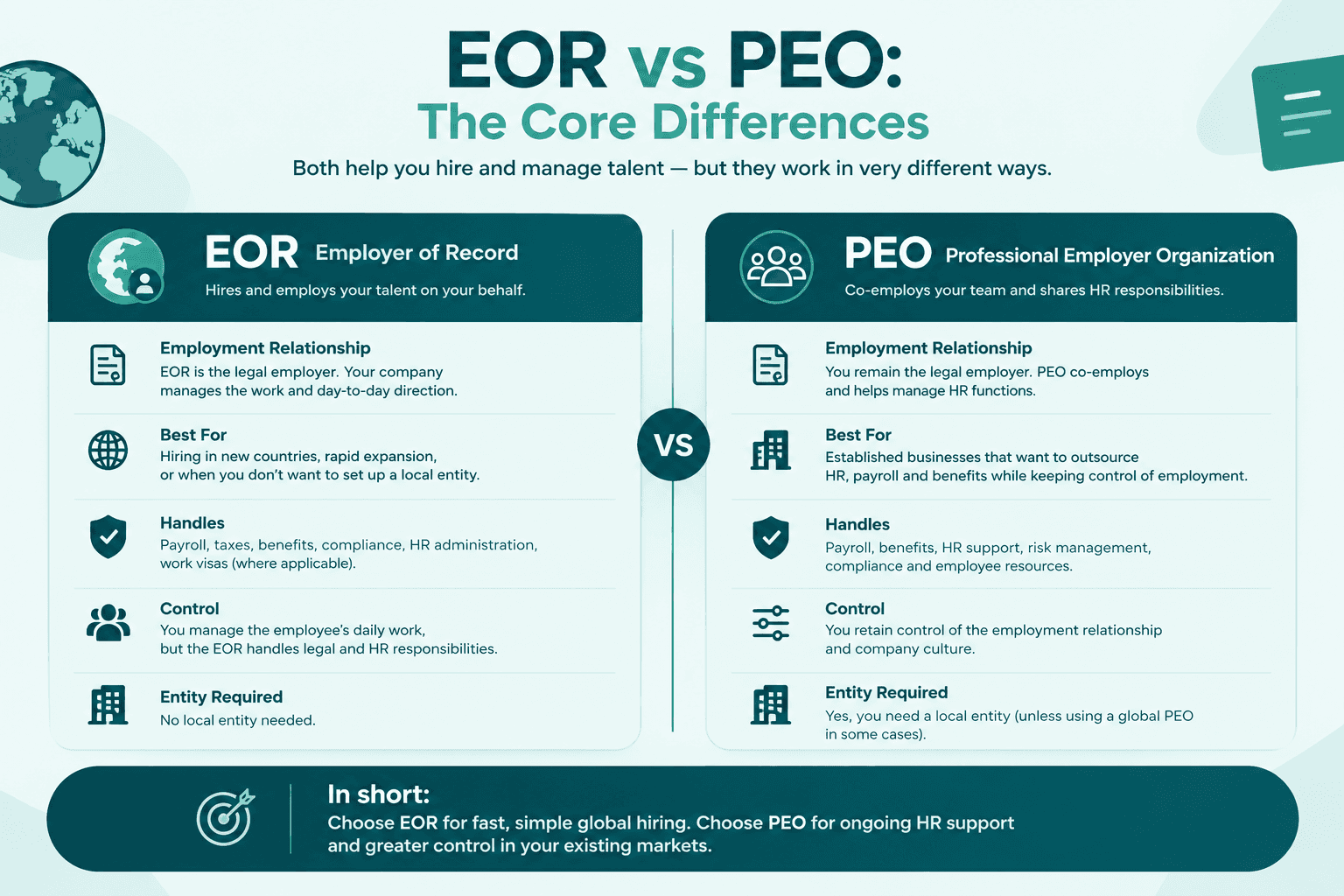
The distinction that matters most is who legally employs the worker, and what that means for where each model can actually be used.
Factor | EOR | PEO |
Legal employer | The EOR itself | Co-employment, you remain the legal employer |
Entity required | Not required in the hiring country | Required, you must already be registered there |
Geographic reach | International, often 100+ countries | Domestic, limited to where you are registered |
Setup time | Days | Weeks, since you need an entity first |
Liability | EOR carries most compliance risk | Shared between you and the PEO |
Best fit | Hiring where you have no legal entity | Scaling headcount where you already operate |
Both models take the burden of running payroll and compliance off your plate. Where they split is geography, plain and simple. An EOR exists specifically to solve the no-entity problem. A PEO assumes that the question has already been settled.
Why Entity Requirements Are the Real Dividing Line
Most write-ups on EOR vs PEO spend their time on payroll mechanics and end up burying the one question that actually decides which model you need: do you have a registered legal entity in the country where this person will work?
If the answer is no, a PEO simply isn't on the table, regardless of price or service quality, because co-employment legally requires an existing entity to co-employ into. This isn't a minor technicality. It rules PEOs out entirely for a company hiring its first person in the Philippines, its first person in Colombia, or its first person in South Africa, since almost no growing company holds a registered entity in any of those countries before it starts hiring there.
An EOR sidesteps that problem completely. It already holds the local entity and the local compliance infrastructure, so you never have to build any of that yourself just to make one hire. That's the entire reason EORs exist, and it's the single biggest reason companies building distributed teams across Latin America, Southeast Asia, or Africa default to an EOR rather than a PEO.
Cost Comparison: EOR vs PEO
PEO pricing usually comes as either a flat per employee monthly fee or a percentage of payroll, commonly somewhere between roughly 2 and 12 percent depending on the provider and how much is bundled into it. Since PEOs operate domestically, that cost sits on top of whatever local payroll and benefits already cost in that state.
EOR pricing typically works as a flat monthly fee per employee, commonly landing in the 300 to 700 dollar range depending on the country and provider, covering payroll processing, statutory benefits, local contracts, and ongoing compliance monitoring. Because the EOR already owns the local entity and infrastructure, there's no separate entity setup cost sitting on top, which is where most of the real savings show up once you compare EOR pricing against the actual cost of registering a foreign entity yourself.
The honest comparison isn't EOR against PEO in the abstract. It's EOR against the true cost of setting up and maintaining your own foreign entity, and PEO against the cost of running domestic payroll and HR in house. Looked at that way, an EOR usually wins on cost for international hiring, and a PEO usually wins on cost for domestic scaling, simply because each one is solving the problem it was actually built for.
Speed to Hire
An EOR can typically get a new international hire onto payroll within days of the contract being signed, since the legal entity and compliance groundwork already exist. A PEO can move fast too, but only once your company has finished entity registration in that location, and that step alone commonly takes weeks to months depending on the country or state. If you need to make an offer this week, that gap in setup time is often the deciding factor before cost even enters the conversation. A candidate who has other offers on the table is not going to wait around for your entity paperwork to clear.
Which One Fits Where You Are Hiring

The right choice depends heavily on where your hire is actually located, and the regions companies pull talent from most often, each come with a different answer.
The Philippines has one of the deepest pools of remote and BPO-trained talent anywhere, built on decades of supporting US companies, but almost no company hiring there for the first time already holds a Philippine entity. An EOR is the practical path.
Latin America offers real-time overlap with US business hours, a big reason companies hire there for client-facing and collaborative roles. The same entity problem applies here too. Countries like Colombia, Mexico, and Argentina each require their own local registration, so an EOR that already operates across the region saves you months of setup for every new country you add.
South Africa sits between the other two regions on cost, with strong English fluency and full overlap with US East Coast working hours. As with the other two, an EOR lets you hire your first person there without registering a local entity first.
A PEO only becomes the right tool once you already have an established legal presence in a country or state and just want help managing the HR administration of hiring more people there, which is a domestic scaling problem rather than a global expansion one.
What to Actually Check Before You Choose
Whichever model fits your situation, a few things are worth confirming before you sign anything. Ask how many countries or states the provider actually operates its own entities in, versus where it's leaning on a third-party partner network, since that affects both reliability and cost. Ask how compliance updates get handled when local labor law changes, and whether that monitoring happens automatically or falls on you to track. Ask what currencies and payout methods are supported, and what the effective foreign exchange rate actually is once fees are baked in, since that's usually where hidden costs hide. And confirm exactly what happens if you need to offboard someone quickly, termination rules vary enormously by country, and a good provider should be able to walk you through the process for your specific location before you ever need it. None of these questions take long to ask, and skipping them is usually how a company ends up locked into a provider that cannot actually support the country it just hired into.
Where Globaltize Fits In
Globaltize is built around the international hiring side of this whole decision. Through a direct partnership with Thera, Globaltize gives companies Employer of Record coverage across 150+ countries, along with contractor payments in 130+ currencies, automatic invoice generation, localized employment and contractor contracts, and ongoing regulatory change monitoring so compliance doesn't fall on your team to track manually. That sits on top of Globaltize's core recruitment service, which means you're not just getting the legal and payroll infrastructure to hire internationally, you're getting the vetted candidates to actually fill those roles, across the Philippines, Latin America, South Africa, and beyond.
Final Thoughts
EOR vs PEO isn't really a question of which service is better. It's a question of which problem you actually have. If you need to hire someone in a country or state where you have no legal entity, an EOR is the only model built to solve that. If you already operate in that location and just want help managing HR administration for the people you employ there, a PEO can be the more cost-effective route. Getting this right at the start saves months of rework later, since switching models mid-hire is far more disruptive than just choosing correctly the first time.
Frequently Asked Questions
Can a PEO be used to hire someone internationally?
Generally, no. Co-employment requires the client company to already hold a registered legal entity in that location, which most companies simply don't have when hiring in a new country for the first time. An EOR is built specifically to remove that requirement.
Is an EOR more expensive than a PEO?
Not usually, once you compare them the right way. An EOR typically costs a flat monthly fee per employee with no separate entity setup cost. A PEO's fee sits on top of whatever it costs to register and maintain your own entity in that location, which is often the bigger expense for international hiring.
How fast can a company hire through an EOR compared to a PEO?
An EOR can usually get someone onto payroll within days, since the local entity and compliance infrastructure already exist. A PEO can't begin until your company has finished its own entity registration in that location, which commonly takes weeks to months.
Do EOR and PEO providers handle the same compliance responsibilities?
Not quite. An EOR carries most of the legal and compliance risk as the official employer. A PEO shares that responsibility with your company through co-employment, so your business retains more of the liability than it would under an EOR arrangement.
Can a growing company use both an EOR and a PEO at the same time?
Yes, and plenty do. A common setup pairs a PEO for domestic hiring in the state where the company already operates with an EOR for every hire made outside that footprint, since each model is solving a different geographic problem rather than competing for the same one.